One blender, two glasses: portioning a smoothie
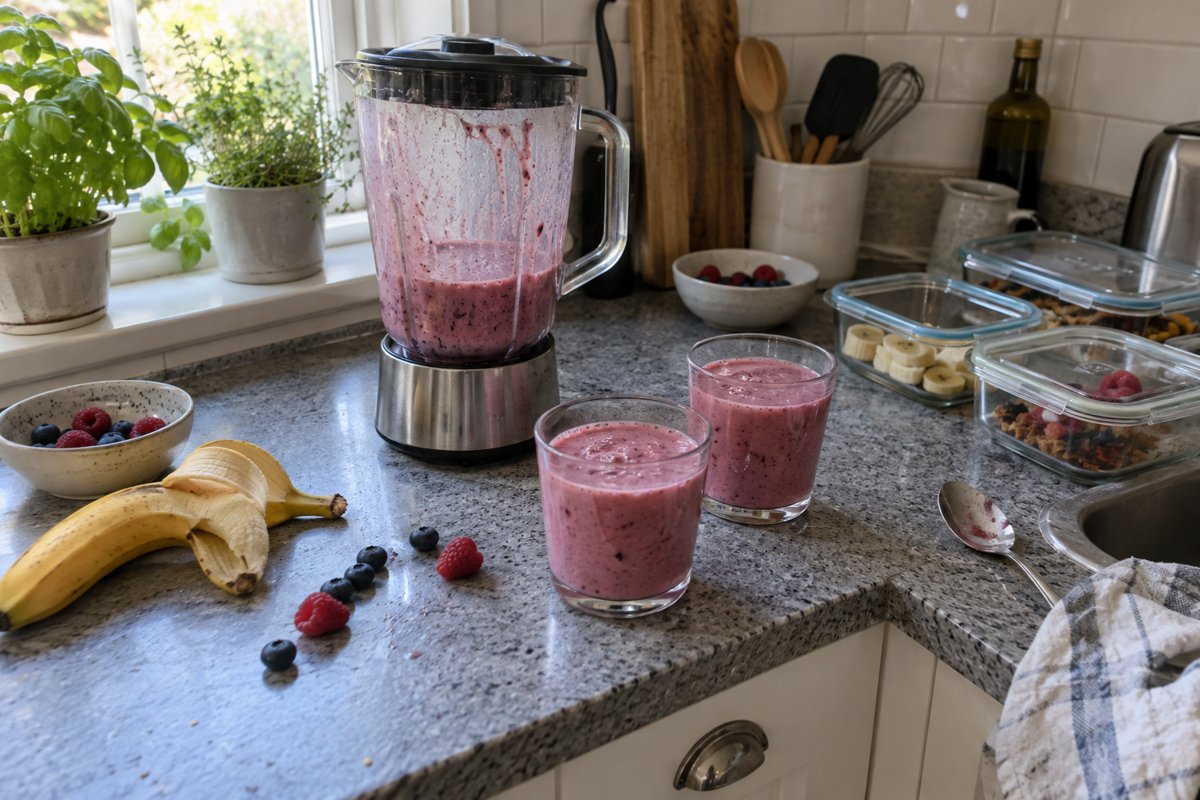
A full blender jug looks like one drink. It’s easy to pour the lot into the biggest glass in the cupboard and call it breakfast. But when I actually measured what my usual smoothie makes, it came to just over 600 ml. That’s four of the 150 ml glasses from my drink portions reference, not one.
So now I think of the blender as a soup pot: it makes a batch, and the batch gets divided.
My berry smoothie
Recipe note · Makes about 600 ml (4 small glasses)
- 150 g frozen mixed berries
- 1 small banana
- 150 g plain yoghurt
- 200 ml milk or water
- optional: a squeeze of lemon, a few mint leaves
Put the liquid in the blender first, then the yoghurt, banana and berries. Blend until smooth, adding a splash more liquid if it struggles. Frozen berries mean you don’t need ice, and they make it thick enough to feel like breakfast rather than juice.
Measuring the finished jug
Most blender jugs have markings on the side, but mine are faded and printed at 250 ml intervals, which isn’t much help. So I pour the finished smoothie into my kitchen measuring jug once, note the total, and then pour it into glasses. With this recipe, it’s usually 600 to 650 ml depending on the banana.
From there, the arithmetic is easy. Two people having it with breakfast get two 150 ml glasses each, or one each with the rest kept for the next morning. If you prefer a bigger glass, that’s fine; the useful thing is knowing what “a glass” means in your kitchen.
Keeping the rest
Smoothies are best fresh, but a covered glass or a jar in the fridge keeps well until the next morning. It separates a little; a quick stir or shake fixes it. I pour leftovers into a jar with a lid straight away rather than leaving them in the blender jug, which otherwise ends up in the fridge for two days and becomes a project to wash.
Sometimes I freeze the extra in an ice-cube tray. A few smoothie cubes blended with fresh milk make a quick second batch, and it’s a neat way to use the last bit without anyone having to drink it.
The same smoothie, different jobs
I make three versions, all written down with quantities:
- Breakfast version: as above, with a tablespoon of oats blended in. It becomes a different drink entirely, which is why my reference table says “without extras”.
- Afternoon version: berries, half a banana and water instead of milk. Lighter, more like a fruity drink.
- Green version: a handful of spinach added to the breakfast version. You can’t taste it, honestly. The colour is another matter.
Each one gets measured once and noted. Same habit as the overnight oats: once the quantities are written down, I can make it the same way on a sleepy Tuesday.
A small thing about glasses
My smallest tumbler holds about 250 ml to the brim. A 150 ml portion fills it a little over halfway, which looks a bit stingy until you’re used to it. I now use a short, narrow glass for smoothies, and 150 ml looks exactly like what it is: a decent glass of smoothie.
That’s the funny thing about portions in glasses. The amount doesn’t change; only the glass does. Which is why I’ve stopped trusting my eyes and started trusting the jug.