Rice, dry and cooked: the conversion I keep forgetting
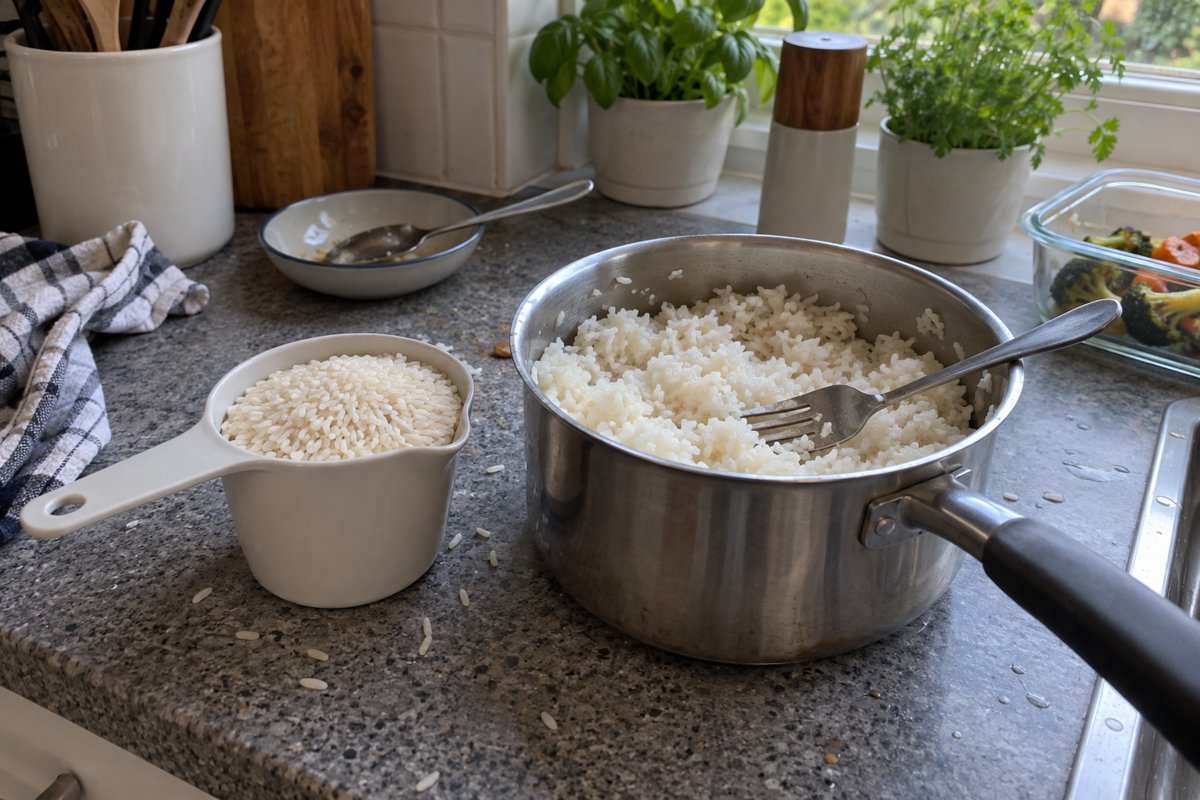
I know rice grows when it cooks. Everybody knows that. And yet, left to my own judgement, I still pour enough into the pan for a small wedding. Something about those tiny grains makes a cupful look modest, right up until the lid starts lifting.
So this is a short note about the one conversion I keep forgetting, and the card I eventually taped inside the cupboard door so I don’t have to remember it.
How much does rice grow?
As a rough guide, white rice about triples in weight when it’s cooked, because it absorbs so much water. Brown rice grows slightly less in the same time, and it varies with the variety, the method and how long you leave it. In my kitchen, these are the figures that hold up:
| Rice | Dry | Cooked, roughly |
|---|---|---|
| White long-grain | 75 g | 220–230 g |
| Basmati | 75 g | 210–230 g |
| Brown rice | 75 g | 190–210 g |
| Risotto rice | 75 g | depends on the stock |
I use 75 g dry per person as my starting point for a main meal with rice as the base, and a bit less when it’s a side. That’s a number I arrived at by writing things down, not one I’d insist on for anyone else. Appetites vary, and so does what else is on the plate.
Weighing versus cups
I prefer weighing because it’s repeatable, but I know plenty of people cook with cups. A standard 250 ml cup of dry white rice weighs somewhere around 180 to 200 g, depending on the grain. Half a cup is close to my 75 g-per-person habit for one generous portion, or two smaller ones.
If you use cups, the most useful thing is to always use the same cup. A mug from the back of the cupboard is fine, as long as it’s the same mug every time. That’s the same reasoning behind checking a glass once with water: once you know what your own container holds, you can stop guessing.
Cooking it so the numbers work
My everyday method for white rice is the absorption method:
- Rinse the rice in a sieve until the water runs mostly clear.
- Put it in a pan with about one and a half times its volume of water and a pinch of salt.
- Bring to the boil, cover, turn the heat right down and leave for 12 minutes.
- Turn off the heat and leave it covered for another five minutes, then fluff with a fork.
Follow the packet if it says something different. Different rice really does behave differently, and the packet usually knows best.
Portioning cooked rice
When I meal prep for the week, I weigh the whole pan of cooked rice (minus the weight of the pan, which I wrote on a sticky note years ago) and divide by the number of boxes. It takes thirty seconds and stops the last box from being mostly vegetables.
For dinner, I don’t weigh. I use a serving spoon and the fist comparison as a rough guide, because it’s quicker and nobody wants a scale on the table.
A note on leftovers
Cooked rice needs a bit of care. I cool leftovers quickly, spread out in a shallow container, and get them into the fridge within an hour or so. I eat them within a day and reheat until steaming hot all the way through. That’s simply what the food safety guidance recommends, and it’s easy to follow once it’s a habit.
The card in my cupboard says: 75 g dry each. About three times heavier cooked. Same cup every time. It isn’t much, but I haven’t cooked rice for a wedding since.