Why I started weighing my pasta
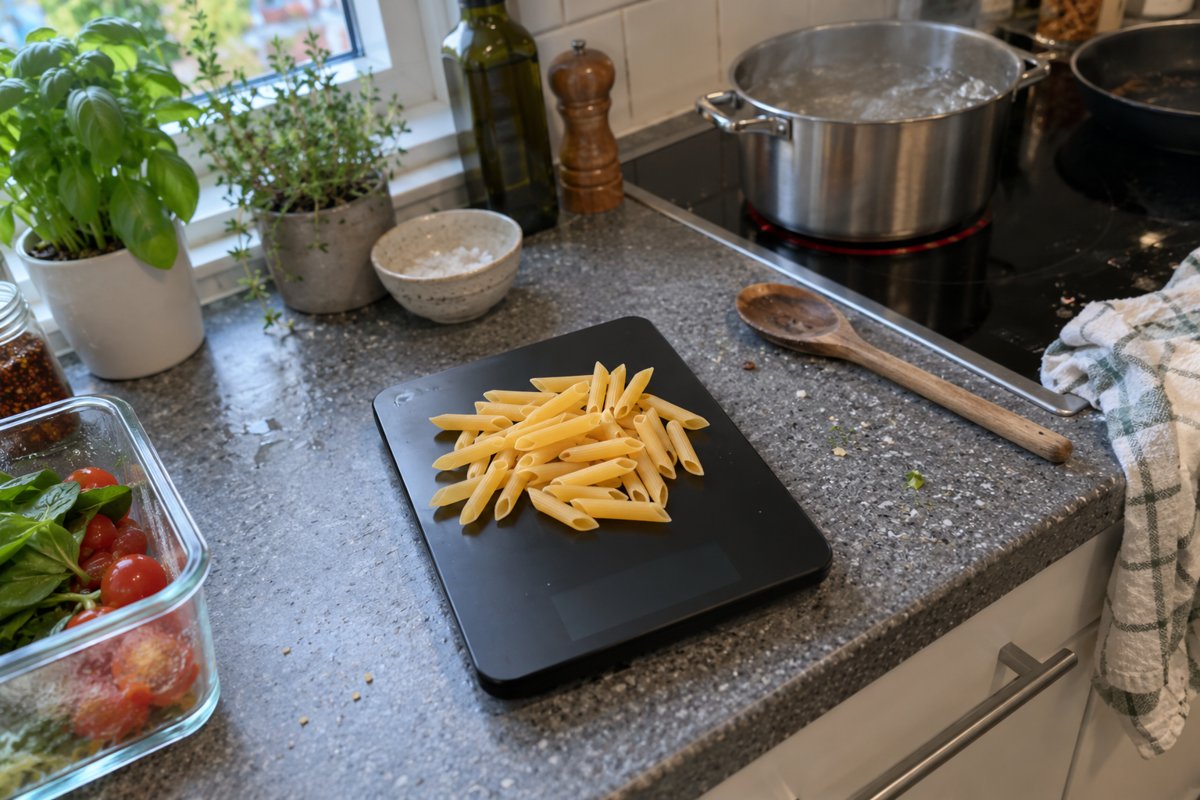
For years I cooked pasta the way my dad did: tip the bag over the pan until it looks about right, then add a bit more “just in case”. The result was always the same. Either a mountain of leftover penne going stiff in the fridge, or, on the evenings I tried to be careful, two people looking at their plates wondering where the rest was.
The problem isn’t that guessing is wrong. It’s that dry pasta is very hard to judge by eye. A small handful of spaghetti looks like nothing, and a bowlful of short shapes looks like a lot until it doubles in the water. So this summer I put a cheap digital scale on the worktop and started weighing it. That’s really where this notebook began.
The number I started with
Most packets suggest somewhere around 75 to 100 g of dry pasta per person for a main meal. I started at 80 g each, which sits comfortably in that range, and wrote down what happened. For the two of us on a weeknight, with a vegetable sauce, 160 g turned out to be just right. With a lighter sauce, or a big salad alongside, we sometimes go a little lower. When friends come round and there’s nothing else on the table, I go up.
None of this is a rule. It’s a starting point I can repeat, which is the whole idea. If I know I used 160 g last Tuesday and there was a spoonful left over, next Tuesday I can try 150 g without guessing.
Dry weight, cooked weight
The other thing I learned quickly: always note whether a weight is dry or cooked. Pasta roughly doubles to two and a half times its weight as it absorbs water, depending on the shape and how long it boils. So 80 g dry ends up somewhere around 180 to 200 g on the plate. If you weigh cooked pasta and compare it with a dry figure on a packet, you’ll think you’re eating twice as much as you are, or the other way round.
I now write “80 g dry” in my notes, never just “80 g”. It’s a tiny habit that saves a lot of confusion later, especially with rice, which I’ve given its own conversion note.
A weeknight tomato sauce for two
Recipe note · Serves 2
- 160 g dry penne or spaghetti
- 1 tablespoon olive oil
- 1 small onion, finely chopped
- 1 garlic clove, sliced
- 1 tin (400 g) chopped tomatoes
- a handful of spinach or a few chopped courgette slices
- salt, pepper, a pinch of dried oregano
Soften the onion in the oil over a low heat for about eight minutes, add the garlic for one more minute, then the tomatoes and oregano. Let it bubble gently while the pasta cooks. Stir the spinach in at the end until it wilts. Drain the pasta, keeping a splash of the cooking water, and toss everything together, loosening with the water if it looks dry.
I measure the oil with a spoon rather than pouring from the bottle. That habit gets its own explanation in the hand-portion cheat sheet, but the short version is that a spoon gives me the same amount every time.
What I write down
My notes for a recipe are short:
- the dry weight of the pasta and how many people it fed
- what the sauce was, and whether there was anything else on the table
- whether there was too much, too little or just enough
After a few weeks, a pattern appears. Mine says: 80 g dry each with a vegetable sauce, 70 g each when there’s bread and salad, and never trust the shape of the bag.
Why bother?
Partly it’s about not throwing food away. A heap of leftover pasta that nobody really wants on Thursday is just a slow route to the bin. Partly it’s about not running out of ideas: once the base quantity is sorted, I can play with sauces without worrying that the plates will look strange.
And partly it’s just satisfying. I like knowing that a recipe will turn out the same way twice. The scale lives on the worktop now, next to the salt.